Tag: zuko

  • Gold in the Cracks: Rewriting Honour in Zuko’s Journey

    Gold in the Cracks: Rewriting Honour in Zuko’s Journey

    Now that the Avatar: The Last Airbender franchise may hopefully be returning to the big screen, it feels like a good time to revisit why a show that aired nearly two decades ago continues to resonate so strongly with its viewers. Created by Michael Dante DiMartino and Bryan Konietzko, the series is often praised for its worldbuilding, but what has truly allowed it to age so well is its character writing.

    While Avatar does draw from familiar archetypes it consistently subverts them. These are not static tropes, but evolving identities.

    To me, Zuko’s character arc stands out as one of the most compelling explorations of identity.

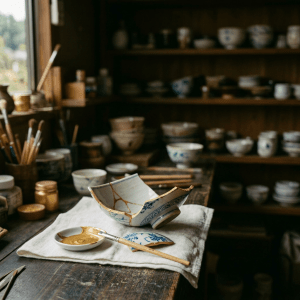
    His arc mirrors the Japanese art of kintsugi: the practice of repairing broken pottery with gold, not to hide its damage, but to make it part of the object’s history. Zuko’s journey is not one of simple redemption, but of reconstruction. He does not return to who he was before he broke; instead, he becomes someone new by confronting the very fractures that once defined him.

    The First Fracture

    Zuko’s story begins at the moment of fracture. Branded a failure by his father, Fire Lord Ozai, he is burned and exiled after speaking out of turn during an Agni Kai. The scar he carries is not just physical, it is the visible line where his identity splits. Before this moment, he is a prince shaped by expectation; after it, he becomes something unfinished, defined by absence, rejection, and the need to be restored.

    This moment defines his entire worldview.

    Like shattered pottery, Zuko tries to gather his pieces in the only way he understands: by pursuing the Avatar. His pursuit of the Avatar is not initially about justice or balance. It is about restoration. He believes capturing Aang will restore his honour and, more importantly, earn him his father’s approval.

    But this “honour” is never truly his. It is conditional, externally defined, and rooted in violence. From the beginning, Zuko is chasing something denied to him not because he lacks worth, but because he refused blind obedience, something Ozai demanded of him.

    This is the illusion at the heart of Zuko’s early arc: he is not trying to become whole, but to become acceptable.

    Learning How to Be Whole

    Unlike Ozai, who defines worth through obedience and power, Iroh offers something Zuko does not yet understand care without condition. Once a celebrated general, Iroh carries fractures of his own, shaped by war and personal loss. Yet rather than allowing those breaks to harden into cruelty, he has already begun to remake himself. In this sense, Iroh is not simply a guide…He is an example of what it means to live as something that has been repaired.

    Importantly, Iroh never forces Zuko back into shape. Where Ozai burns and demands, Iroh waits and listens. He does not strip Zuko of his anger or confusion, but makes space for it, offering quiet alternatives: reflection instead of reaction, tea instead of control, patience instead of force. His guidance is subtle, but deliberate. He teaches Zuko that restoration cannot be imposed from the outside; it must be chosen.

    This is what makes their relationship so critical to Zuko’s reconstruction. Iroh does not “fix” him. Instead, he creates the conditions in which Zuko can begin to see that he is not beyond repair and more importantly, that he does not need to return to who he was before in order to become whole.

    In contrast to Ozai’s conditional approval, Iroh’s presence introduces a different possibility: that the cracks do not need to be hidden or erased but understood. That they can, in time, become part of something stronger.

    When the Cracks Reopen

    Zuko’s decision in Ba Sing Se reveals how fragile that process truly is and how incomplete his understanding of honour remains.

    After traveling with Iroh and witnessing the consequences of the Fire Nation’s actions, Zuko comes closer than ever to redefining himself. For a brief moment, it seems as though the broken pieces are beginning to hold that he might act in alignment with what he has begun to recognise as right, rather than what he has been taught to pursue.

    And yet, when faced with the opportunity to regain his honour, Zuko turns back.

    His choice to side with Azula and betray Iroh is not simply a relapse, but a misalignment. He abandons the internal understanding he has begun to form, in favour of the external validation he has always chased. In doing so, he returns to a version of honour defined not by integrity, but by approval by his father, his nation, and the system that first broke him.

    This is what makes the moment so critical. Zuko is no longer ignorant of the difference between the two definitions of honour. He has seen it, questioned it, even begun to live by it. But when forced to choose, he cannot yet sustain that alignment.

    Like a piece repaired through kintsugi, the cracks do not disappear simply because they have been mended once. Under pressure, they can reopen. Zuko’s relapse does not erase his growth; it exposes its limits. His desire for acceptance still outweighs his commitment to what he knows, however faintly, to be right.

    When he later finds that regaining his “honour” brings him no sense of wholeness, the contradiction becomes impossible to ignore. What he has achieved is recognition without alignment…and it feels empty.

    This realization marks a turning point: for the first time, Zuko is forced to confront that honour cannot be given to him. It must come from acting in accordance with what he believes, even if it costs him everything.

    Gold in the Cracks

    Zuko’s decision to join Aang marks the first moment in which his actions fully align with what he believes to be right.

    Unlike his earlier attempts at change, this choice is not driven by impulse, anger, or the desire for approval. It is deliberate and difficult. By turning against the Fire Nation, Zuko knowingly gives up the very thing he once believed would make him whole: his father’s acceptance. In doing so, he finally rejects honour as something granted to him and redefines it as something he must live out.

    Becoming Whole

    Like kintsugi, the repair is not about returning to an original state, but about creating something new from what has been broken. Zuko does not discard his past: His anger, his mistakes, his longing for belonging but neither does he allow them to dictate his future. Instead, he integrates them, allowing those fractures to inform his choices rather than control them.

    His later role as Fire Lord reflects this transformation. Where Ozai ruled through domination and unquestioned authority, Zuko leads with reflection and restraint. Power, for him, is no longer something to obey or wield without question, but something to examine and use responsibly. In this way, he does not simply inherit his nation’s legacy he reshapes it.

    Importantly, Zuko’s growth is not defined by perfection, but by consistency. He does not become “good” by erasing who he was, but by aligning his actions with what he now understands to be right, even when it is uncomfortable or costly. This alignment is what gives his transformation weight. It is what makes it lasting.

    The gold in kintsugi does not hide the cracks it makes them visible. In the same way, Zuko’s past remains a part of him. But it no longer represents something to overcome or deny. Instead, it becomes the very foundation of the person he chooses to be.

    In redefining honour, Zuko ultimately redefines himself and in doing so, he breaks not only from his father’s expectations, but from the cycle that shaped them. Choosing, at last, to build something better from what once broke him.

  • When Belief Becomes Performance

    When Belief Becomes Performance

    A World That Doesn’t Pause

    Many things are happening in the world that it almost feels strange to list them. War. Rising costs. Political figures collapsing under the weight of their own contradictions. Religion being used, questioned, defended, attacked. At any other point in history, events like these might have felt defining, almost like they demanded something from us like our attention.

    And yet, life goes on in a way that feels almost disconnected from it all. We wake up, go to work, meet friends, eat, sleep. The world does not seem to stop anymore, not even in the face of things that should shake it.

    Maybe it’s because everything has become a kind of war. A war on drugs. A war on disease. A war on ideas. When everything is framed as conflict, nothing feels exceptional anymore.

    Even the loss of life, something that should always feel personal, gets reduced to language like “collateral’’, “safety’’ etc.

    I am writing this appeal to you

    Do our intentions matter anymore or have we been conditioned to just give opinions.


    Why We Say Anything

    I guess before going further, I should acknowledge the obvious irony: this piece is itself an opinion. I am adding to the very noise I am questioning.

    So my intention matters here.

    I am not trying to convince anyone to think a certain way. If anything, I am trying to offer a perspective that can be challenged. A healthy debate, to me, is only as good as the arguments presented on both sides. To take a position seriously is to give it enough weight that it can stand against criticism.

    But how many opinions today are actually formed that way?

    Because there is a difference between an opinion formed to understand, and one formed to be seen.

    We have always had an element of performance in who we are. William Shakespeare captured it long before:

    They have their exits and their entrances,
    And one man in his time plays many parts,
    His acts being seven ages.’’

    William  Shakespeare

    This isn’t new, we have always played roles depending on where we are and who we are with. But something has changed. The stage has become constant. And the audience is no longer limited it is everywhere.

    I believe if Shakespeare were to write this in today’s day and age he would mention ‘His acts being eight ages’.


    Social Media: The Stage Without End

    Social media may not have created performance, but it definitely refined it.

    It rewards visibility, consistency, and alignment. It does not take long to notice that what is presented is rarely the full picture. Influencers curate versions of their lives. Public figures signal causes through symbols and statements. Even ordinary people, in smaller ways, learn what to show and what to hide.

    And it’s not always done in an obvious way, it’s subtle.

    • It’s the hesitation to express something that might be unpopular.
    • It’s the instinct to self-censor and frame a thought in a way that will be accepted.
    • It’s the quiet awareness that approval can be lost.

    So opinions now shift not always to what is true, but to what is safe.

    At the same time, the pace of everything accelerates. Our opinions are expected quickly. React now. Respond now. Take a stance before the full picture is even clear.

    We like to think that more perspectives lead to better understanding. But the reality feels different.

    The more we scroll, the less we seem to process.

    Studies on information overload suggests that constant streams of content don’t sharpen thinking they exhaust it. What we call engagement may just be cognitive strain in disguise. Instead of forming ideas, we react to them. Instead of reflecting, we respond.

    And the systems we use reinforce this, algorithms don’t show us everything, they show us what keeps us there. Familiar views, comfortable agreements, and just enough opposition to keep things interesting, but not enough to disrupt the safe space carefully curated.

    So we exist in spaces where our opinions feel validated, even when they haven’t been deeply examined.


    The Mask We Speak Through

    There’s another layer to this that feels harder to ignore.

    It’s how different we can be depending on who is watching.

    There are thoughts we share publicly, and thoughts we keep private. There are opinions we are comfortable attaching our names to, and others we would rather leave unsaid. Sometimes, the people closest to us our friends and family are the ones we don’t want seeing our online selves.

    That split is strange when you think about it.

    Oscar Wilde once wrote,

    Give a man a mask, and he will tell you the truth.”

    It’s unsettling about how well that fits.

    Social media can act as that mask. It allows for a kind of expression that is unabashed, raw and unfiltered but also detached and self-focused. Agreement turns strangers into allies. Disagreement can turn even familiar voices into opposition.

    And somewhere in that dynamic, it becomes harder to tell what is actually believed, and what is simply being performed.

    Which brings the question back to intention.

    If an opinion is shaped by audience, by pressure, by the need to belong or to be seen…what is it, really?

     And who are we really?


    What Are We Standing On?

    It also raises a deeper question about morality.

    Many of us subscribe, consciously or not, to some form of relative morality, where values shift depending on context. If that is the case, what truly anchors our decisions?

    If opinions are constantly changing, influenced by environment and feedback, are we standing on anything stable at all?

    Or are we building our worldview on something closer to shifting sand that is only as steady as long as nothing challenges it too directly?

    Without intention, without reflection, it becomes difficult to tell the difference between what we believe and what we have performed to absolve ourselves from the burden of considered thought.


    What Remains

    It feels strange to arrive at a conclusion here, because this is not something that resolves cleanly. This piece itself could be dismissed as just another opinion. And maybe that’s fair. Maybe it proves the point. But there is something that feels worth holding onto.

    We don’t merely have opinions anymore, we have deadlines for them.

    And that changes the nature of how they are formed.

    It makes the world feel faster, louder, and in some ways, less certain. Because while we can learn to recognise patterns in nature, like the way the sea behaves before a storm, the signs of a rope being frayed, we never fully know the true intentions of man.

    And if intention is what gives an opinion its weight, then losing sight of it matters more than we realise.

    Maybe that is not for us to fully know. Maybe that sits somewhere beyond us, between people, and whoever is left to judge it.

  • A New Year’s Reflection: One Step at a Time

    A New Year’s Reflection: One Step at a Time

    Another year has passed and with it come the opportunity of starting our new year’s resolutions and working towards fresh goals. I love the idea of starting a new; be it a new month or even phase of our life. It portrays something that is often missing in our daily news or even in our daily conversations, Hope.

    While we cannot ignore the conditions of a troubled world, be it economic turmoil, geopolitical tensions, wars and famine. These challenges have been with us in varying degrees for as long as history has been recorded. We see them unfolding, but often it feels like nothing improves at least to the naked eye, sometimes giving the sense that there is no point continuing with the charade of everything being fine.

    But with the new year while new troubles may arise, new opportunities also extend their hands to us.

    I find it fitting that after the month of Christmas, the season of Love, Hope and Peace we enter the new year. It’s a reminder for us to carry those values into the new year. Christmas shows us that love means sacrifice, that hope can be found even in a humble manger and that peace is something we can all strive towards in interactions with the world around us.

    It’s not always easy. Personally, when I am slighted, my instinct is to defend myself, but I’ve learnt that taking a moment to pause before reaction helps a ton in clearing the mind. Small steps like this are part of why I enjoy entering the new year, even if we enter with simple resolutions like spending less time (5 mins or even 1 hour) on the mobile. Even that small change is progress.

    Often, when we look toward moving forward, we want progress to come quickly and results to appear instantly. But taking intentional steps in the present makes looking back at the path we’ve created all the more rewarding.

    Imagine walking on a sandy beach in haste, then walking on it with intention, taking in the ocean and life around you. Which set of footprints would be more striking?

    In The Screwtape Letters, a witty book by C.S Lewis that features two demons, Wormwood and Screwtape, exchanging letters on the best way to corrupt a soul, there is a salient quote from Screwtape. ‘For the Present is the point at which time touches eternity.’

    Many times, I forget the blessing that is the present day in search for something I may not find tomorrow or something that I may not need in search of my own greed and ambition.

    If there’s one thing to take away from this post, it’s this:

    Before the sun reaches its peak in the sky, it passes through the beauty of the sunrise, where not on the sun itself but everything the light touches, is admired. In the same way, living intentionally in each present moment can help us see both the world and ourselves more clearly.