Tag: cartoon

  • Reporting for Duty: The Superman Story in Between the Lines

    Reporting for Duty: The Superman Story in Between the Lines

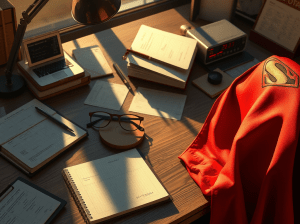
    I have a few thoughts on the James Gunn, Superman movie.

    Who is Superman

    Before we begin, let’s first understand who is Superman. Superman aka Kal-El, was born on Krypton. His biological parents Jor-El and Lara sent him to earth shortly before Krypton was destroyed. His ship landed in the American countryside of Smallville, Kansas, where he was found and adopted by farmers Jonathan and Martha Kent, who named him Clark Kent.

    The Kents realized he was superhuman; due to the Earth’s yellow sun, all of his physical and sensory abilities are far beyond those of a human. Growing up his adoptive parents instilled in him strong morals, he chooses to use his powers to benefit humanity, and fights crime as a vigilante.

    To protect his personal life, he changes into a primary-colored costume and uses the alias “Superman”. Clark resides in Metropolis, and works as a journalist for the Daily Planet.

    [Thank you Wikipedia!]


    His Identity

    The earliest scenes of the movie begins with him interacting with videos of his biological parents and how he finds it soothing. It helps to inform him on his role on earth as a protector. In a way, its not just informing him but also affirming his actions.

    In fact, his biological parents words govern the actions he takes in the movie. Many times we also look to our loved ones as guiding pillars on our morals, ideas and even how to act. We are shaped not just by our own thoughts but also by how others view us.

    In the movie, these words give Superman his meaning. So when it is suspected that there was more to the story and advice provided by his biological parents, Superman (understandably)does not take it well. His whole world is shifted and turned upside down and whatever he thought he knew or who he was ends up turning into a lie.

    But while it bogs Superman down for a while, it acts as a catalyst for him to question what his beliefs, intentions and actions. It pushed him to find out who he was without the noise and words from his biological parents.

    His relationship with his adoptive parents and conversation with his father help him in finding his own path despite what other might say. In fact, the beauty of the movie is the lack of correction from the characters. It doesn’t matter what is being said anymore but only what is being done.


    Lois Lane as an Anchor

    When we see his interaction with Lois Lane we see another side to their dynamic that I enjoyed. Many times Lois Lane is presented as the no nonsense reporter but never with Clark/Superman as the subject.

    But the tables turn, when we see Clark allow himself to be interviewed by her in an act of trust. We see how both of their morals and integrity as journalists and heroes play out. Bringing across an interesting but much needed dynamic. When we want to better ourselves, we need to be challenged. I believe that the reason why Lois and Clark in this film are a believable couple is because of this challenge, and to see it play out in a trusting and vulnerable way gave insight into their dynamic. We know Lois trusts him but she also takes her role as a journalist seriously especially with the backdrop of the movie.

    Unlike Lex Luthor who views Superman as a being to be controlled and destroyed because of his infallible power. Lois challenges Clark/Superman to defend his choices and in a way unearth any uncertainties regarding them. It pushes him to see that people may not see his actions in the same vein.

    The Journalism Aspect

    The fact that Superman and many of his peers are reporters adds an intriguing layer to the story. At its core, the role of a good reporter is to seek the truth and carefully examine sources. Clark initially believes he already knows the truth and trusts his own intentions, but when his world is turned upside down, he’s forced to reevaluate what he truly believes and uncover what’s really happening.

    Similarly, Lois recognizes that the situation is far more complex than the media portrays it, and her trust in Clark/Superman drives her to dig deeper. In this way, journalism, and the shared commitment to truth, becomes a powerful force that connects them, pushing both to pursue their quests for understanding despite starting from different perspectives.


    I Guess That’s The Real Punk Rock

    I really enjoyed the movie and aimed to keep this spoiler-free, but I think beyond how the movie showed that Kindness can be a superpower these areas and themes stood out to me the most. I appreciated how the story wrapped up this dynamic in a way that stayed true to the characters and provided extra nuances and layers without compromising either.

  • AI: Artificial Intelligence or All Intelligence?

    AI: Artificial Intelligence or All Intelligence?

    Since the establishment, and now almost widespread use of AI chatbots like ChatGPT and Copilot, studies have been done citing their effects on the human mind and trust me it doesn’t look too good.

    WALL-E Begins?

    A recent study from MIT media lab found that people who used ChatGPT to help write their work form them, recorded one of the lowest cognitive engagement and performance with low scores in areas of linguistic and neural brain paths.

    (Well, I guess it’s time to hang up the banners of joy that AI was supposed to make our tasks and lives easier)

    I remember being hesitant in using AI, particularly ChatGPT when it first came out, my fear was that I would basically be pushing all my thinking somewhere else. Later I experimented on it based on one of my biggest weaknesses (organisation), I don’t know if you can tell from my writing, but I am terrible at organising my thoughts and let me tell you when I used Chat to help me…It didn’t get what I was going for at all.

    So maybe it’s not as brilliant as everyone claims it is, especially when you find out that any answer you get is an amalgamation of all the possible resources and answers available online. (which sounds great until you realise you need a specific one!)

    But I am not anti-AI in fact I found that sometimes it forced me to think more. For instance, when I tried using it to help me organise my writings, I realised that I had to put way more time and effort trying to get it to understand me, especially since I did not take the first thing it threw out.

    (Which eventually resulted in me using the old fashion way of organising my thoughts- grabbing a pen and paper and asking the ultimate authority (my mom) if it sounds right.)


    Impacts of AI

    But the issue of AI chat tools goes far beyond reducing linguistic and neural scores. While I am a novice in the field, certain things are clear to me as a writer. My biggest concern is that students and people may eventually become over-reliant on these bots on churning on information and data, that we may lose the ability to think creatively when we are faced with challenges or ideas. In a way, because of how the bot works we will eventually be thinking in a hive mindset when dealing with things in the world.

    My new Therapist

    Another worrying development is that a study found that many young people confide in AI chat tools as they would a real human therapist. While there are some benefits such as being judgement free (really?), instant availability and providing tools and resources for cognitive reframing. The core tenants of therapy such as human connection, non-verbal cues and accountability are removed. A study by Dr Andrew Clark, a psychiatrist, while posing as a troubled teen and experimenting on different chatbots he received different responses. He categorised them as such:

    • Some chatbots would provide beneficial and basic information on mental health and direct people to the right resources.
    • But with complicated or dangerous scenarios many of the chatbots responded in in risky ways suggesting impulsive behaviour.

    This misunderstands the greatest impact of therapy, which is knowing that someone is listening and challenging you to be a better person. However, with AI chat tools, tweaking the way you write something can absolve you from mistakes you do not wish to address. In a way, it feels like using these tools as therapists can hinder your growth and in worse cases lead you to making bad choices.

    We already see this happening with an AI company being sued due to their lack of regulation which may have resulted in the death of a teenage boy in Florida.


    Eco Woes

    Lastly, with all the clamouring on the importance of sustainability and eco-friendly goals. AI chat bots have a huge impact on one of earth most scarce resource, water. A global report estimated that data centers consume about 560 billion litres of water annually and that could rise to about 1,200 billion litres by 2030. Especially, with the push of technology firms for larger networks and more offices. This is a serious concern, the overuse of water-a finite resource- on AI can have catastrophic effects on our ecosystem and society.

    This is particularly concerning, when you realise many data, centres are usually hosted in cities with high population density like China, India, USA etc. In fact, a 2021 paper found that nearly half of US data centres were fully or partially powered by water-hungry power plants located within water scarce regions.

    Many things we use require a certain water usage but the lack of tact in managing or addressing this issue beforehand is astonishing when you think about its implications.

    Overall while it seems that AI while it may have its benefits, it’s cost in human cognitive abilities, growth and the world’s resources may not actually be worth it without stricter guidelines.


    Moving Forward

    I am not usually one for regulation, but it seems plain to me that the tech industry particularly in the creation of AI tools and its vast networks were under regulated for the sake of innovation. But with the dangers looming close by, it would only be right for companies and governments to place stringent ethical guidelines and codes regarding AI. This should go beyond its use in academics, but also in copyright infringement, access and use of resources, particularly finite ones.

    During BCG’s 6th annual Digital Acceleration Index (DAI), out of 2,700 executive globally, found only 28% of their organizations are prepared for new regulation regarding AI.

    Many firms can start prepping for these potential changes through Responsible AI (RAI) initiatives. At it’s core it is a set of principles to account for transparency, privacy, security, fairness and inclusion and accountability when developing and deploying an AI algorithm.

    Some ways to kickstart at RAI initiatives in companies:

    1. Align internal AI policies with AI regulations in effect in the market you operate in.
    2. Dialogue with public sector officials and others to better understand the evolving regulatory landscape, as well as to provide information and insights that might be useful to policymakers.
    3. Establish clear governance and risk management structures and protocols and accountability mechanisms in managing AI technologies.

    Right now, responsive (not reactive) action is needed to catch up to these changes. Policymakers need to have sufficient subject matter expertise available to implement, monitor and enforce the policies and engage in multilateral processes to make AI rules among jurisdictions interoperable and comparable.

    But it seems like laws and policies may be running a losing race due to having a late start.

    Credit: Image is by rawpixel.com

  • Death: An Old Friend

    Death: An Old Friend

    Death is an old friend, that many times we never speak to. It comes in its mystery but is always dependable in its actions. One of my favourite depictions of death and the dead is from Greek mythology when Hades, the god of the underworld, snatches Persephone away down, because that is the characteristic of the death and the underworld. His actions are driven by the domain he rules and the reactions from her mother is not so different from ours ,when death knocks at our door.


    Philosophy on Death

    Death has been an age old question and many philosophers have written extensively on the topic:

    Socrates believed death would either lead to a dreamless sleep or a blank wall (nothingness), or a passage way to another life. But it would be pointless to be fearful, regardless of what death would greet us with.

    The Vedas, views all beings as souls and spiritual in nature, after death a soul is reincarnate, taking birth in another form (Think of it like how hermit crabs find new shells when they outgrow their old ones).

    Plato, believed death opened up the door to an ideal world and from the horses mouth: “I am afraid that other people do not realize that the one aim of those who practice philosophy in the proper manner is to practice for dying and death.” Freeing the idea of the body from the mind (sounds familiar?)

    Epicurus ever the pragmatic, believed death was simply the cessation of sensation-not good or bad. Making it inconsequential to us. He asserted our fear of death was the one thing holding us back from living lives of tranquility and fulfillment.

    The Stoic school of philosophy emerged in 3rd century Greece argued the time to perfect our virtues and live life to the fullest is today—by meditating on our mortality as a reminder that tomorrow might not arrive.

    Roman emperor and Stoic philosopher Marcus Aurelius said:

    “Do not then consider life a thing of any value. For look to the immensity of time behind thee, and to the time which is before thee, another boundless space. In this infinity then what is the difference between him who lives three days and him who lives three generations?” [Meditations, 4.50]

    Sixteenth century French philosopher Michel de Montaigne wrote extensively about being meditative on death, urging the plain and simple premeditation of death as a way to learn how to die: “To begin depriving death of its greatest advantage over us, let us deprive death of its strangeness, let us frequent it, let us get used to it; let us have nothing more often in mind than death.”

    Twentieth century French philosopher Jean-Paul Sartre saw death as a reflection of our meaningless existence. ”I think of death only with tranquility, as an end. I refuse to let death hamper life. Death must enter life only to define it.” Which at least opens up the conversation abit more.

    Otto Rank, the first existential therapist, said it best: “some refuse the loan of life to avoid the debt of death.” His solution the idea on the ”courage to be” –developing the strength to love knowing loss, to create knowing destruction, to connect knowing separation.

    Finally, 17th century Dutch philosopher Spinoza believed that when you’re dead, you’re dead … and preferred to focus on the joys of living rather than meditating on The End. Spinoza bought into Socrates’s notion that the unexamined life wasn’t worth living


    Death: Friend or Foe?

    If you are wondering what the answer is (Tough luck I’m clueless too). But I believe the answer may lie in between the ideas of meditating on death and thinking nothing of it.

    Personally, the concept of death was introduced to me early on through my religion. Like others I find comfort in discussing death and having layers to it with the variations of the afterlife.

    As a Christian, a verse I find that treads the ground of both meditating and thinking nothing of death is :

    ‘For me, to live is Christ, to die is gain’ – Philippians 1:21.

    The verse looks at death as a combination of what we read earlier from philosophers. It does not diminish the fact that death will come but it is knowing that you should live for something greater than yourself . The writer, Paul was a man that constantly faced death in his journey. When he wrote this, it was clear his current actions and its purpose, mattered despite staring death in the face. His philosophy of seeing it head on but knowing there is so much more was one of the things that fueled his life ambition.

    I don’t have the answers to death but I do want to leave you with the understanding that maybe there is something in your life be it religion, family, peers or your passion that can help you navigate and converse with your age old friend death.